AI Training · Knowledge Base

AI Training for Companies

Practical AI upskilling for the mid-market: on this page you and your employees learn everything essential about artificial intelligence — from the foundations and prompt engineering to the AI literacy duty under Art. 4 EU AI Act. Freely accessible, based on our knowledge base with 120 teaching units.
120Teaching units
10Modules — from foundations to roll-out
3Learning paths: 60, 120 or 150 hours
2,400+Pages of knowledge base behind it
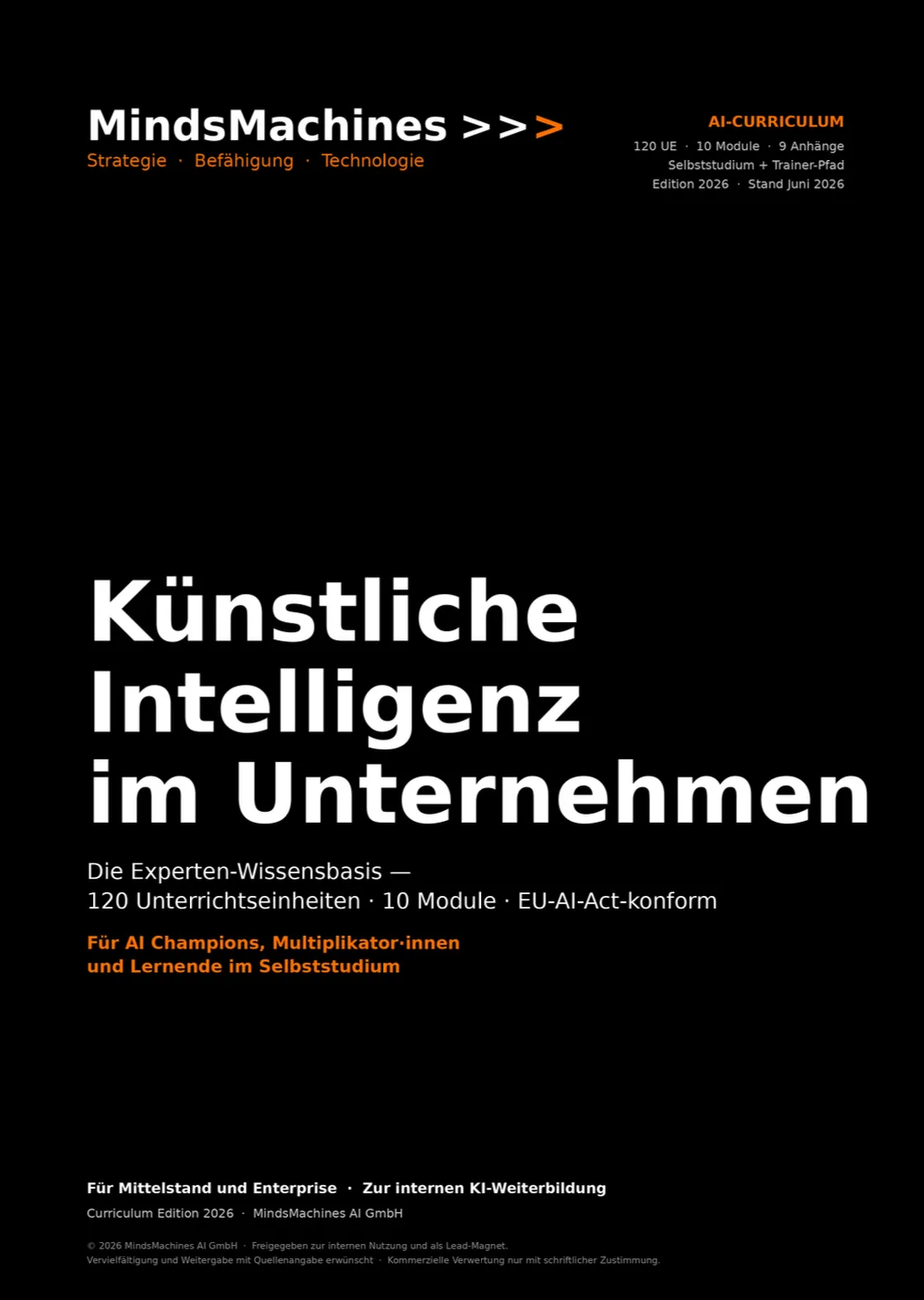
Cover of the MindsMachines AI knowledge baseKnowledge base · PDFThe complete knowledge base as PDF2,400+ pages · 10 modules · June 2026 edition · free by emailRequest the knowledge base as PDF

The essentials

What is AI training — and why is it now mandatory?

AI training (AI literacy) gives employees the knowledge to use AI systems competently, safely and lawfully. Since 2 February 2025, Art. 4 of the EU AI Act (Regulation (EU) 2024/1689) obliges every company using AI to take measures ensuring a sufficient level of AI literacy among its staff — demonstrable and role-based.

  • Legal basis: Art. 4 Regulation (EU) 2024/1689 — in force since 2 February 2025, no transition period.
  • It covers all employees who work with AI systems — not just IT or compliance.
  • The scope follows role and risk class of the systems used (three competence levels).
  • Without documentation, training counts as not having happened — evidence is part of the duty.
  • This page covers the foundations; the full knowledge base deepens all 10 modules.

Status: July 2026 · June 2026 edition of the AI knowledge base

EU AI Act

Understanding the AI Act: timeline, addressees, risk classes.

The EU AI Act (Regulation (EU) 2024/1689) is directly applicable EU law — not a recommendation. It applies to every company that uses AI systems professionally: as a deployer you are an addressee even if you only use AI and never develop it. Understanding the system of deadlines and risk classes lets you place your duties with confidence.

The five key dates of the AI Act

  1. 1 August 2024Entry into force

    Regulation (EU) 2024/1689 enters into force; obligations phase in gradually.

  2. 2 February 2025Prohibitions + AI literacy

    Prohibited practices (Art. 5) and the AI literacy duty (Art. 4) apply — to all providers and deployers.

  3. 2 August 2025GPAI & governance

    Obligations for general-purpose AI models (incl. large language models) and the governance structure with the AI Office apply.

  4. 2 August 2026High-risk & transparency

    The main application: duties for high-risk systems under Annex III and transparency duties under Art. 50 apply.

  5. 2 August 2027Embedded systems

    Transition ends for high-risk AI in regulated products under Annex I (e.g. machinery, medical devices).

Practical point: the competence duty under Art. 4 already applies — whether or not your company uses high-risk systems.

The four risk classes — explained interactively

The EU AI Act does not regulate “AI as such” but concrete applications by their risk. Tap a level of the pyramid to see examples and duties.

Unacceptable risk · Art. 5

Practices incompatible with fundamental rights are banned in the EU — no exceptions for companies.

  • Social scoring by public authorities
  • Manipulative AI steering behaviour subliminally
  • Emotion recognition in the workplace
  • Untargeted scraping of facial images

Use prohibited. Violations: up to €35m or 7% of global annual turnover (Art. 99).

High risk · Annex I + III

Allowed but strictly regulated: systems with significant impact on people's life chances. Most relevant for companies: Annex III No. 4 — AI in HR.

  • AI-supported CV screening and performance evaluation
  • Credit scoring
  • Assessment systems in education and training
  • Critical infrastructure and law enforcement

Conformity assessment, risk management, human oversight, logging, system-specific training (Art. 26(5)).

Limited risk · Art. 50

Transparency duties: people must be able to recognise they are interacting with AI or seeing AI-generated content.

  • Customer-service chatbots (must identify themselves)
  • AI-generated images and videos (labelling)
  • Deepfakes (strict labelling duty)

Labelling and information duties — implementable technically and organisationally.

Minimal risk · No specific duties

The vast majority of office AI: writing assistants, summaries, translation, spell checking. Here “only” the general competence duty of Art. 4 applies.

  • Text and e-mail assistants
  • Summarisation and translation tools
  • Spam filters, recommender systems
  • Predictive maintenance for machines

No specific obligations — but Art. 4 (AI literacy) applies to all users.

Rule of thumb from the knowledge base: most office tools are “minimal” or “limited”. As soon as AI decides about people — hiring, credit, performance — it becomes high-risk.

Fines: up to €35m or 7% of global annual turnover for prohibited practices; tiered lower for other violations (Art. 99).

Deep dive

AI literacy under the EU AI Act

Risk check for your applications, the nine deployer duties under Art. 26, traffic-light approval model and competence matrix, the compliance deep dive on the training duty.

To the deep-dive page

AI literacy · Art. 4 EU AI Act

The AI literacy duty: what Art. 4 demands of your company.

Art. 4 EU AI Act obliges providers and deployers to take measures ensuring, to their best extent, a sufficient level of AI literacy of their staff — considering their role, the risk level of the systems used and their technical knowledge. The legislator prescribes no rigid curriculum, but role-based, demonstrable competence building.

Key takeaway from the knowledge base: Art. 4 has applied since 2 February 2025. Whoever cannot show documented training measures risks being classified as non-compliant in audits — even if the AI systems in use meet every requirement.

Three levels of AI literacy

All employees who use AI tools

The mandatory base for every workforce, regardless of the risk level of the systems used.

  • What is AI and how does it fundamentally work?
  • Recognising limits: hallucinations, bias, knowledge cut-offs
  • Data-protection basics when using AI
  • Reviewing AI output critically instead of trusting blindly

Regular AI users, sensitive contexts

For everyone integrating AI productively into their work — with deeper method and legal knowledge.

  • Designing, optimising and reusing prompts
  • Validating AI output in a structured way
  • Applying GDPR and the AI Act in daily work
  • Knowing and using escalation paths

AI owners, high-risk oversight, project leads

For everyone responsible for AI systems, overseeing high-risk applications or shaping governance.

  • Implementing deployer duties under Art. 26 in full
  • Detecting, assessing and addressing bias
  • Conducting fundamental-rights impact assessments
  • Designing and running AI governance structures

Reference framework: the five DigComp dimensions

The EU Commission uses the DigComp framework (latest: DigComp 2.2, 2022) as the reference for digital competence. Applied to AI, five dimensions emerge that a complete AI training programme should cover:

Information and data literacy

Understanding which data AI systems use, how data quality shapes output — and which data you may enter.

Communication and collaboration

Integrating AI assistants sensibly into communication processes and framing results correctly.

Digital content creation

Writing prompts, reworking AI-generated content and understanding copyright questions.

Safety

Keeping confidential data out of external tools, spotting AI-powered phishing, applying data protection.

Problem solving

Choosing suitable AI tools, evaluating outputs critically, recognising hallucinations and escalating errors.

Documentation duties: no evidence, no compliance

For internal governance and supervisory authorities alike: what is not documented did not happen. Your organisation should keep these four records:

  • Training record per person: name, date, content, level, duration, trainer or provider
  • Competence matrix of the organisation: who holds which level? Who is missing? When are refreshers due?
  • Risk-based mapping: which system has which risk class — and which competence level does it require?
  • Review cadence: annual refreshers, immediate training for new tools or system changes

Learning paths

Three routes through the same knowledge base.

Self-study, multiplier training or an AI-champion programme: the knowledge base is built so every role finds its fitting path — the same content at different depths.

60 hours

Self-study

Employees building foundational AI literacy

The direct route to Foundation competence under Art. 4: learning texts, exercises and reflection questions at your own pace.

  • Focus on modules 1–4
  • Exercises for your own workplace
  • Knowledge checks for self-assessment

120 hours

Multipliers

L&D, HR and internal AI coaches

The path for everyone passing knowledge on: full modules plus didactic notes and exercise guides.

  • All 10 modules
  • Trainer notes per unit
  • Method catalogue for workshops

150 hours

AI Champions

AI owners and project leads

The complete programme including trainer appendices, model solutions, ROI guide and readiness assessment.

  • Advanced level under Art. 4
  • Project work with transfer plan
  • Certificate-ready structure

Curriculum

10 modules, 120 teaching units — the complete programme.

This is the full structure of the AI knowledge base. Open each module, read goals and key messages — and tick off what you have worked through. Your progress is stored locally in your browser.

Your learning progress0/10

Learning goal: You explain what artificial intelligence is, distinguish AI, machine learning, deep learning and generative AI, and understand — at a non-technical level — how large language models work.

The conceptual foundation: what is AI, and why is the topic actionable right now? The answer unfolds on three levels: technical (how do AI systems work?), economic (why do they spread so fast?) and workplace (what does that mean for knowledge work?). Accessible without technical background.

Key messages

  • AI is the umbrella term; machine learning learns from data, deep learning uses deep neural networks, generative AI creates content instead of merely classifying.
  • Language models generate text probabilistically, token by token — hence their strengths (language, structure) and limits (facts, recency).
  • Hallucinations are a system property, not an exceptional bug — handling them professionally is learnable.

Teaching units

  1. Unit 1 Terminology: AI, ML, DL, GenAI — taxonomy & boundaries
  2. Unit 2 History of AI — from Turing to GPT-5 (milestones)
  3. Unit 3 AI ecosystem 2026 — providers, models, open vs. closed source
  4. Unit 4 How does an LLM work? Tokens, embeddings, context window
  5. Unit 5 Training types — supervised, unsupervised, reinforcement, RLHF
  6. Unit 6 Strengths & limits of today's AI — what AI can(not) do
  7. Unit 7 Understanding hallucinations — causes and countermeasures
  8. Unit 8 Multimodality — text, image, audio, video, code
  9. Unit 9 Market overview: ChatGPT, Claude, Gemini, Mistral, Copilot, Perplexity
  10. Unit 10 Impact on job profiles & the labour market (IAB studies)
To the deep-dive page

Learning goal: You classify the four risk classes of the EU AI Act, explain the duties from Art. 4 and Art. 26, apply GDPR principles to AI use and draft the outline of an internal AI policy.

The legal backbone of the curriculum — application-oriented rather than academic: understanding legal requirements far enough to make informed decisions and recognise risks. From GDPR basics through the AI Act to copyright, works agreements and a full case study.

Key messages

  • The EU AI Act applies to everyone using AI professionally — as a deployer you are an addressee even without developing AI.
  • Most office tools are minimal or limited risk; AI in HR is the most common high-risk case (Annex III No. 4).
  • GDPR and AI Act complement each other: data protection guards personal data, the AI Act governs system safety and transparency.

Teaching units

  1. Unit 11 AI maturity models for companies
  2. Unit 12 Progress check 1 (quiz and reflection)
  3. Unit 13 GDPR basics in the AI context
  4. Unit 14 Avoiding personal data in prompts
  5. Unit 15 EU AI Act: structure, timeline, addressees
  6. Unit 16 Risk classes of the EU AI Act
  7. Unit 17 Deployer duties under Art. 26 EU AI Act
  8. Unit 18 AI literacy duty under Art. 4 EU AI Act
  9. Unit 19 Copyright and AI-generated content
  10. Unit 20 Trade secrets and confidentiality in the AI context
  11. Unit 21 Ethics frameworks: OECD, EU HLEG and Asilomar
  12. Unit 22 Bias, fairness and discrimination through AI
  13. Unit 23 Works agreement on AI
  14. Unit 24 Case study: legal assessment of an AI use case
To the deep-dive page

Learning goal: You structure prompts with the five-layer model (role, context, task, format, constraints), apply zero-shot, few-shot and chain-of-thought, and build your own prompt library.

The practical core skill all application modules build on: giving AI systems precise, structured instructions. Prompt engineering is no secret science but a learnable method of precise communication — whoever thinks and writes clearly learns it fast.

Key messages

  • Input quality determines output quality — vagueness, overload and missing context are the three most common mistakes.
  • A precise 80-word prompt beats a vague 400-word one — length is not a quality metric.
  • Recurring tasks belong in a versioned prompt library, not in individual colleagues' heads.

Teaching units

  1. Unit 25 Anatomy of a prompt — role, context, task, format
  2. Unit 26 Zero-shot vs. few-shot prompting
  3. Unit 27 Chain-of-thought & reasoning techniques
  4. Unit 28 System prompts & persona design
  5. Unit 29 Structured outputs (JSON, Markdown, tables)
  6. Unit 30 Iterative prompting & refinement loops
  7. Unit 31 Negative prompts, constraints, guardrails
  8. Unit 32 Prompt patterns (CRISPE, RTF, TAG, RISEN)
  9. Unit 33 Working with long documents — summarisation strategies
  10. Unit 34 Building & versioning a prompt library
  11. Unit 35 Meta-prompts & AI-assisted prompt optimisation
  12. Unit 36 Practice: 10 prompts for your own workplace
To the deep-dive page

Learning goal: You integrate AI assistance into real workflows — e-mail, meetings, writing, research, knowledge management, presentations — keeping quality control with humans.

From skill to routine: how to build AI support into daily workflows without fragmenting the work. Every unit has an extended practice variant with strategies for teams and organisations — including the 90-minute hands-on lab “A workday with AI assistance”.

Key messages

  • Productivity gains come from a few well-integrated routines, not from more tools.
  • Source criticism and fact-checking are mandatory skills — AI research does not replace verification.
  • Shared prompt libraries scale knowledge across teams — with awareness of uniform results.

Teaching units

  1. Unit 37 Productivity AI overview (Copilot, Gemini for Workspace, ChatGPT Enterprise)
  2. Unit 38 E-mail triage and reply drafts with AI
  3. Unit 39 Minutes, summaries and action items from meetings
  4. Unit 40 Writing: proposals, reports, blog posts
  5. Unit 41 Translating, rephrasing, tone adjustment
  6. Unit 42 Research with AI search engines: Perplexity and You.com
  7. Unit 43 Source criticism and fact-checking AI answers
  8. Unit 44 Knowledge management with NotebookLM and similar tools
  9. Unit 45 Generating presentations with Gamma and Copilot PPT
  10. Unit 46 Accessibility: alt texts, plain language, inclusive wording
  11. Unit 47 Personal productivity routines with AI
  12. Unit 48 Hands-on lab: a workday with AI assistance (90 minutes)
To the deep-dive page

Learning goal: You use AI for formulas, data cleaning, pivot analyses and reporting, know the limits of statistical reliability of LLM analyses and respect data protection throughout.

Prompting skill meets the most practical application area: structured data and office tools. From natural-language Excel formulas through Code Interpreter to controlling forecasts — including when LLM analyses are the wrong tool.

Key messages

  • AI explains and generates formulas reliably — quantitative analysis needs tools like Code Interpreter, not raw text generation.
  • Before any upload: check data classification, anonymise personal data.
  • LLMs describe patterns well but do not calculate reliably — always verify numbers.

Teaching units

  1. Unit 49 Excel/Sheets with AI — generating formulas in natural language
  2. Unit 50 Data cleaning with AI (duplicates, formats, validation)
  3. Unit 51 Pivot and dashboard suggestions by AI
  4. Unit 52 Creating charts & visualisations automatically
  5. Unit 53 Introduction to Code Interpreter / Advanced Data Analysis
  6. Unit 54 CSV and PDF analysis with LLMs
  7. Unit 55 Data protection when uploading sensitive data
  8. Unit 56 AI in controlling — forecasts and variance analyses
  9. Unit 57 Power BI / Looker with AI copilot
  10. Unit 58 Mini case: optimising reporting
  11. Unit 59 Limits of statistical reliability of LLM analyses
  12. Unit 60 Practice: analysing your own dataset
To the deep-dive page

Learning goal: You write image prompts with structured methods, know application fields from transcription to video generation and recognise legal and ethical risks of synthetic media.

From text to all modalities — with a balanced, informed view instead of hype or rejection: what can image, audio and video AI actually do, where are the limits, and which guardrails do marketing and internal communication need? Including deepfake detection and trademark law.

Key messages

  • Image prompting follows learnable patterns: composition, style, light — iteration beats luck.
  • AI-generated media are subject to labelling duties (Art. 50) and trademark law — approval processes belong in every workflow.
  • Deepfake risks concern every company — detection literacy is part of security culture.

Teaching units

  1. Unit 61 Image generation: Midjourney, DALL·E and Stable Diffusion
  2. Unit 62 Image prompting: composition, style and light
  3. Unit 63 Image editing with AI: inpainting, upscaling, background removal
  4. Unit 64 Legal aspects of generated images and trademark law
  5. Unit 65 Speech-to-text and transcription
  6. Unit 66 Text-to-speech and synthetic voices
  7. Unit 67 Video generation: Sora, Runway and Veo
  8. Unit 68 Avatars and AI presenters: HeyGen and Synthesia
  9. Unit 69 Deepfake risks and detection
  10. Unit 70 Use scenarios in marketing and internal communication
  11. Unit 71 Ethical guardrails for synthetic media
  12. Unit 72 Practice: your own explainer clip with AI
To the deep-dive page

Learning goal: You distinguish AI agents from chatbots, understand tool use, RAG and orchestration conceptually, select suitable processes and design human-in-the-loop patterns including ROI math.

The qualitative threshold of the curriculum: from passive assistant to semi-autonomous system that plans, uses tools and executes tasks. That fundamentally changes the risk dimension — and with it the competence requirements for users and leaders.

Key messages

  • Agents = language model + tool access + planning + memory — each layer raises value and risk.
  • RAG connects language models with your own company knowledge — the basis of trustworthy internal assistants.
  • Frequent, rule-based processes with clear value qualify first — monitoring and human approval are mandatory.

Teaching units

  1. Unit 73 No-code automation: Zapier, Make, n8n
  2. Unit 74 Microsoft Power Automate with AI building blocks
  3. Unit 75 AI agents vs. chatbots — architecture overview
  4. Unit 76 Tool use, function calling, the MCP protocol
  5. Unit 77 Understanding retrieval-augmented generation (RAG)
  6. Unit 78 Building custom GPTs and Copilot Studio agents
  7. Unit 79 Orchestrating agents (CrewAI, LangGraph — concept)
  8. Unit 80 Process selection: which tasks suit agents?
  9. Unit 81 Human-in-the-loop design patterns
  10. Unit 82 Monitoring & logging of AI agents
  11. Unit 83 ROI calculation for automations
  12. Unit 84 Practice: your own no-code agent
To the deep-dive page

Learning goal: You identify AI potential along the value chain, prioritise use cases with ICE/RICE, take build-vs-buy decisions and create a 12-month roadmap with a business case.

A change of perspective: from individual application skill to organisational strategy capability. For leaders, multipliers and everyone involved in AI adoption — with potential matrix, use-case canvas, pilot design and governance model.

Key messages

  • Processes before technology: the potential matrix (frequency × rule-basedness × value) finds the right candidates.
  • Pilots need hypotheses, KPIs and abort criteria — otherwise they become endless projects without proof.
  • Without change management and governance, every roadmap stays on paper.

Teaching units

  1. Unit 85 Process capture methods (value stream, SIPOC)
  2. Unit 86 AI potential matrix: frequency × rule-basedness × value
  3. Unit 87 Use-case canvas and profiles
  4. Unit 88 Prioritisation: ICE, RICE, utility analysis
  5. Unit 89 Build vs. buy vs. configure decisions
  6. Unit 90 Assessing data quality & availability
  7. Unit 91 Pilot design: hypotheses, KPIs, abort criteria
  8. Unit 92 Change management & acceptance in teams
  9. Unit 93 An AI governance model for the company
  10. Unit 94 Creating a 12-month AI roadmap
  11. Unit 95 Business-case math (TCO, benefit, payback)
  12. Unit 96 Workshop: identify and finalise 3 use cases
To the deep-dive page

Learning goal: You name attack vectors like prompt injection and data leakage, govern shadow AI, assess vendors, understand sovereignty questions (on-premise vs. cloud vs. EU hosting) and meet documentation duties.

The critical-reflective return after building application skills: dealing systematically with the risks of productive AI use — from technical attacks and organisational blind spots to incident response and the role of the AI officer.

Key messages

  • Shadow AI — private tool use without approval — is already reality in most organisations; governance beats bans.
  • Prompt injection is the most important new attack vector — guardrails and red-teaming belong to operations.
  • Data sovereignty is an architecture decision: on-premise, EU hosting or cloud with clear contracts.

Teaching units

  1. Unit 97 Attack vectors: prompt injection, jailbreaks, data leakage
  2. Unit 98 Defences: red-teaming, guardrails, filters
  3. Unit 99 Detecting and governing shadow AI
  4. Unit 100 Data classification and data minimisation
  5. Unit 101 On-premise vs. cloud vs. EU hosting (sovereignty)
  6. Unit 102 Vendor assessment checklist for AI providers
  7. Unit 103 Quality assurance: evals, test sets, benchmarks
  8. Unit 104 Monitoring in operation (drift, quality, cost)
  9. Unit 105 Documentation duties under the EU AI Act
  10. Unit 106 Incident response for AI incidents
  11. Unit 107 The role of the AI officer in the company
  12. Unit 108 Case study: risk assessment of a use case
To the deep-dive page

Learning goal: You turn learning into a real project: define a use case, build a prototype, evaluate, present — and become effective as a multiplier in your own team.

A closing module with a double function — transfer and synthesis: how does the content actually reach practice, and how do the ten modules connect? With project coaching, exam simulation, colloquium and a transfer plan up to certification.

Key messages

  • Competence shows in projects, not quizzes — which is why the curriculum ends with real project work.
  • Train-the-trainer elements turn learners into multipliers — that is how AI literacy scales internally.
  • The transfer plan anchors what was learned in concrete next steps for your organisation.

Teaching units

  1. Unit 109 Project work intro: defining topic & scope
  2. Unit 110 Project coaching I — use-case definition
  3. Unit 111 Project coaching II — prototyping with AI tools
  4. Unit 112 Project coaching III — evaluation & documentation
  5. Unit 113 Presentation and communication techniques
  6. Unit 114 Multiplier role in your own team — train the trainer
  7. Unit 115 Exam preparation — structure & topics
  8. Unit 116 Written exam simulation
  9. Unit 117 Peer review of project work
  10. Unit 118 Written final exam (90 minutes)
  11. Unit 119 Project presentations & colloquium
  12. Unit 120 Feedback, certificates & transfer plan
To the deep-dive page
0 of 120 units read
  • First stepsFirst unit read
  • Module masterAll units of one module read
  • Halfway there60 of 120 units read
  • Knowledge base completeAll 120 units read
  • Quiz aceKnowledge check with a perfect score
  • AI Act checkEU AI Act self-assessment completed

Knowledge base · Full texts

Read the complete knowledge base for free

All 120 teaching units as full learning texts, with exercises, industry examples, glossary and appendices. No sign-up, right on this site.

Open the full index

Learning sample · Module 3

Prompt engineering: the core skill — learn it right here.

A sample from the knowledge base, complete on this page: how to give AI systems precise instructions. The quality of your input determines the quality of the output — and good prompts follow learnable patterns.

The anatomy of a prompt: five layers

Strong prompts are not luck — they are structure. Tap a layer to see which part of the example prompt it controls:

Example prompt from practice
You are an experienced sales director in a mid-sized machinery company. A long-standing customer signalled dissatisfaction after an 8% price increase and is comparing offers. Draft an e-mail that explains the price increase factually and offers a call. Max. 150 words, professional-personal tone, with subject line. No discount promises, no filler phrases, no invented numbers.

Four proven prompt patterns

Patterns give structure when speed matters. Pick a pattern, copy the template and replace the placeholders:

Role · Task · Format

The fastest pattern for everyday tasks: role, task, format — done.

You are [role]. Create [task/output]. Format: [length, structure, tone].

Task · Action · Goal

Goal-oriented: first the task, then the action, then the measurable goal.

Task: [what is at hand?] Action: [what should the AI do?] Goal: [how is the result measured?]

Capacity · Insight · Statement · Personality · Experiment

The detailed pattern for complex tasks with style and variant requirements.

Capacity/role: [who is the AI?] Insight: [background] Statement: [core task] Personality: [tone, stance] Experiment: [produce 2–3 variants to choose from]

Role · Instructions · Steps · End goal · Narrowing

For multi-step tasks: explicit steps plus narrowing against drift.

Role: [who?] Instructions: [what?] Steps: [1., 2., 3. …] End goal: [what does “done” look like?] Narrowing: [what is out of scope?]

Five checks for every AI answer

From unit 43 of the knowledge base — before adopting an AI output, check it along these five questions:

Correctness

Are factual claims verifiable and correct? Especially with specific numbers without a source: verify.

Completeness

Does the answer cover all aspects of the task — or is part of the requirement missing?

Relevance

Does the content fit context and audience — or did it stay generic?

Consistency

Does the answer contradict itself or known facts from your context?

Usability

Can you use the result directly — or does the real work start now?

Knowledge check

Test your AI literacy.

Eight questions from the knowledge base's progress checks — from foundations to the EU AI Act. Right here, no sign-up.

1 / 8

Since when does the AI literacy duty under Art. 4 EU AI Act apply?

AI glossary

Key terms — explained clearly.

Excerpt from the knowledge base glossary: the most important terms for AI in companies, alphabetical and searchable.

Agent (AI agent)
An AI system that not only answers but plans and executes steps autonomously — with tool access, planning and memory.
AI Act
Regulation (EU) 2024/1689: governs development and use of AI systems in the EU by risk class; directly applicable law.
AI literacy
The knowledge, skills and understanding needed to use AI systems competently, safely and lawfully — mandatory under Art. 4 EU AI Act.
AI Office
EU Commission body founded in 2024; supervises general-purpose AI models and concretises the AI Act through guidance.
Alignment
The research and practice field of designing AI systems to act consistently with human values and intentions.
Annex III (AI Act)
The list of high-risk application areas — incl. employment/HR, education, credit, critical infrastructure, law enforcement.
API
The interface through which software talks to AI models — the basis for integrating AI into your own processes and products.
Attention mechanism
The mathematical core of the transformer architecture: weighs which parts of the input matter for the output.
DPA (data processing agreement)
Contract under Art. 28 GDPR with every service provider processing personal data — including AI vendors.
Bias
Systematic distortion in AI output, usually inherited from training data — can lead to discrimination and must be actively checked.
Chain-of-thought
A prompting technique asking the model to reason step by step — improves results on complex tasks.
Deep learning
A subfield of machine learning using deep neural networks — the technical basis of modern language and image models.
Deployer
An organisation using an AI system professionally under its own responsibility — the AI Act's central addressee group (Art. 26).
GDPR
The EU General Data Protection Regulation: governs every processing of personal data — including prompts and AI training data.
Embedding
A numerical vector representation of meaning: similar content sits close together in vector space — the basis of semantic search and RAG.
Few-shot prompting
Giving the model a few examples of the desired output in the prompt — raises accuracy for format and style.
Fine-tuning
Further training of a base model on your own data or tasks — an alternative or complement to prompting and RAG.
Foundation model
A large, broadly pre-trained base model (e.g. GPT, Claude, Gemini) usable or adaptable for many tasks.
Generative AI (GenAI)
AI that creates content — text, image, audio, video, code — instead of merely classifying or predicting.
GPAI (general-purpose AI)
AI models with a general purpose (incl. large language models); subject to their own AI Act duties since August 2025.
Guardrails
Technical and organisational safeguards limiting AI output — e.g. filters, rules, approval processes.
Hallucination
A plausible-sounding but false AI statement — a system property of probabilistic text generation; demands consistent review.
Human-in-the-loop
A design principle where humans review and approve critical AI decisions — mandatory for high-risk systems.
Context window
A language model's “working memory”: the maximum amount of text it can process at once.
LLM (large language model)
A large language model generating text probabilistically token by token — the basis of ChatGPT, Claude, Gemini and others.
Machine learning
A subfield of AI: systems learn patterns from data instead of being explicitly programmed.
MCP (Model Context Protocol)
An open standard through which AI models access tools and data sources safely — important for agent architectures.
Multimodality
The ability of AI systems to process and produce multiple media forms: text, image, audio, video, code.
On-premise
Running AI systems on your own infrastructure — maximum data sovereignty, relevant for sensitive data and regulation.
Prompt
The input to an AI system: instruction plus context. Prompt quality largely determines output quality.
Prompt injection
An attack where manipulated inputs make an AI system misbehave — the key new attack vector.
RAG (retrieval-augmented generation)
A method retrieving relevant content from your own knowledge sources before answering — for verifiable, company-specific AI answers.
RLHF
Reinforcement learning from human feedback: training with human ratings that makes models more helpful and safer.
Shadow AI
Employees using unapproved AI tools — a widespread compliance risk that needs governance rather than mere bans.
System prompt
The overarching instruction defining an AI assistant's role and behaviour — separate from the user input.
Temperature
A parameter for output variability: low = more deterministic and precise, high = more creative and varied.
Token
The smallest processing unit of language models (word fragments) — the basis of context-window limits and API pricing.
Transformer
The network architecture introduced in 2017 (“Attention is All You Need”) underlying practically all modern language models.
Zero-shot prompting
Posing a task without examples — works for clear standard tasks; few-shot wins for format and style requirements.

FAQ

Frequent questions about AI training.

The questions we hear most often in trainings and consulting — answered compactly.

Yes. Art. 4 of the EU AI Act obliges all providers and deployers of AI systems, since 2 February 2025, to take measures ensuring sufficient AI literacy of their staff. The design is flexible — but the competence level must be demonstrable and oriented to role and risk level.

Three things: first, every employee working with AI needs a competence level appropriate to their role (Foundation, Intermediate or Advanced). Second, measures must reflect the risk level of the systems used. Third, everything must be documented: who was trained when, how long and on what — without evidence, training counts as not having happened.

As a continuous blended-learning programme instead of a one-off seminar: (1) online foundations in self-study (3–5 hours), (2) live training with exercises on real use cases, (3) supported practice in daily work with internal champions, (4) regular refreshers once or twice a year. Transfer competence only emerges through real application.

Our knowledge base structures the field into ten modules: AI foundations, law (EU AI Act, GDPR), prompt engineering (foundations and advanced), data & office integration, multimodality (image/audio/video), AI agents & automation, AI strategy, security & risk management, and transfer & roll-out. Together 120 teaching units — the complete curriculum is on this page.

Depends on the goal: foundational competence for all employees is achievable in self-study in about 60 hours. Multipliers who pass knowledge on plan around 120 hours. AI champions at Advanced level — including project work and a certificate-ready structure — around 150 hours. Anchoring in daily work matters more than the hour count.

No — Art. 4 explicitly demands role-based appropriateness. Three levels have proven themselves: Foundation for everyone using AI tools; Intermediate for regular users in sensitive contexts; Advanced for AI owners and everyone overseeing high-risk systems. Without differentiation you risk overwhelming some and underserving others.

With four records: a training record per person (name, date, content, level, duration, provider), a competence matrix of the organisation, a risk-based mapping of systems to competence levels, and a defined review cadence. A structured programme like the 120-unit knowledge base delivers this evidence with it.

That depends on the system and licence terms. With enterprise products (e.g. M365 Copilot, ChatGPT Enterprise) inputs are contractually excluded from training; with free consumer versions often not. Ground rule for companies: use approved tools only, never enter personal data or trade secrets into unvetted systems.

Plan for hallucinations instead of denying them: review AI outputs as a rule (correctness, completeness, relevance, consistency, usability), demand sources for factual claims or re-research them, and never publish critical content unreviewed. Understanding the cause — probabilistic text generation — makes warning signs like precise numbers without sources much easier to spot.

The free start: work through this learning page and request the full knowledge base as a PDF. For structured team upskilling we offer personalised trainings for every maturity level — from a foundation programme to AI-champion development. Step one is a free initial call in which we assess your organisation's needs and maturity.

Who is behind this

From practice — not from the textbook.

The knowledge base condenses over 25 years of experience in organisational development and the current wave of applied AI — what we see, use and pass on daily in consulting and training mandates.

Johannes Heister

Founder & AI Strategy Architect

Dipl.-Kaufmann (FH) · LL.M. · MIT Certificate in Applied Generative AI

Founder of MindsMachines AI GmbH — an AI engineering & consulting spin-off of the University of St. Gallen. Eleven years of line responsibility and five years of consulting: GenAI transformation, corporate strategy and AI enablement for FMCG, food & retail and industry.

Christian Haaler

Lead AI Transformation & Organisational Development

Psychologist (Dipl.) · Systemic consultant · 25+ years leadership, consulting, change

From Accenture to heading people & organisational development: Christian combines AI change management with psychological depth — leadership advisory, reorganisation and competence building in banking, energy, healthcare and social services.

Vortrag von MindsMachines an der Universität St. Gallen

How this knowledge base is made

Depth needs method. The knowledge base follows a documented creation and quality process:

  • Source-based: legal texts and official documents, scientific sources and vetted practice sources — with references per unit
  • Didactically structured: every unit with learning goals, learning text, industry applications, exercises and reflection questions
  • Continuously updated: versioned editions (current: June 2026) with update notes on legal and market changes
  • Practice-validated: content stems from real training and consulting mandates in the mid-market

Next step

From reading to capability: we make your team AI-ready.

This page lays the foundation — real AI competence grows in training on your own use cases. Personalised AI trainings for every maturity level, documented in line with the EU AI Act.

The platform

OneMachine: your AI, in your system.

Productive AI that runs securely in your organization: with your own data, permissions and approvals. Distilled from real project work into a licensable product.

Explore OneMachine
AI Training for Companies: Courses & the EU AI Act