
Four problem areas in mechanical engineering
Purchasing, sales, material planning and controlling, where scattered Excel islands and SAP exports cost the most.
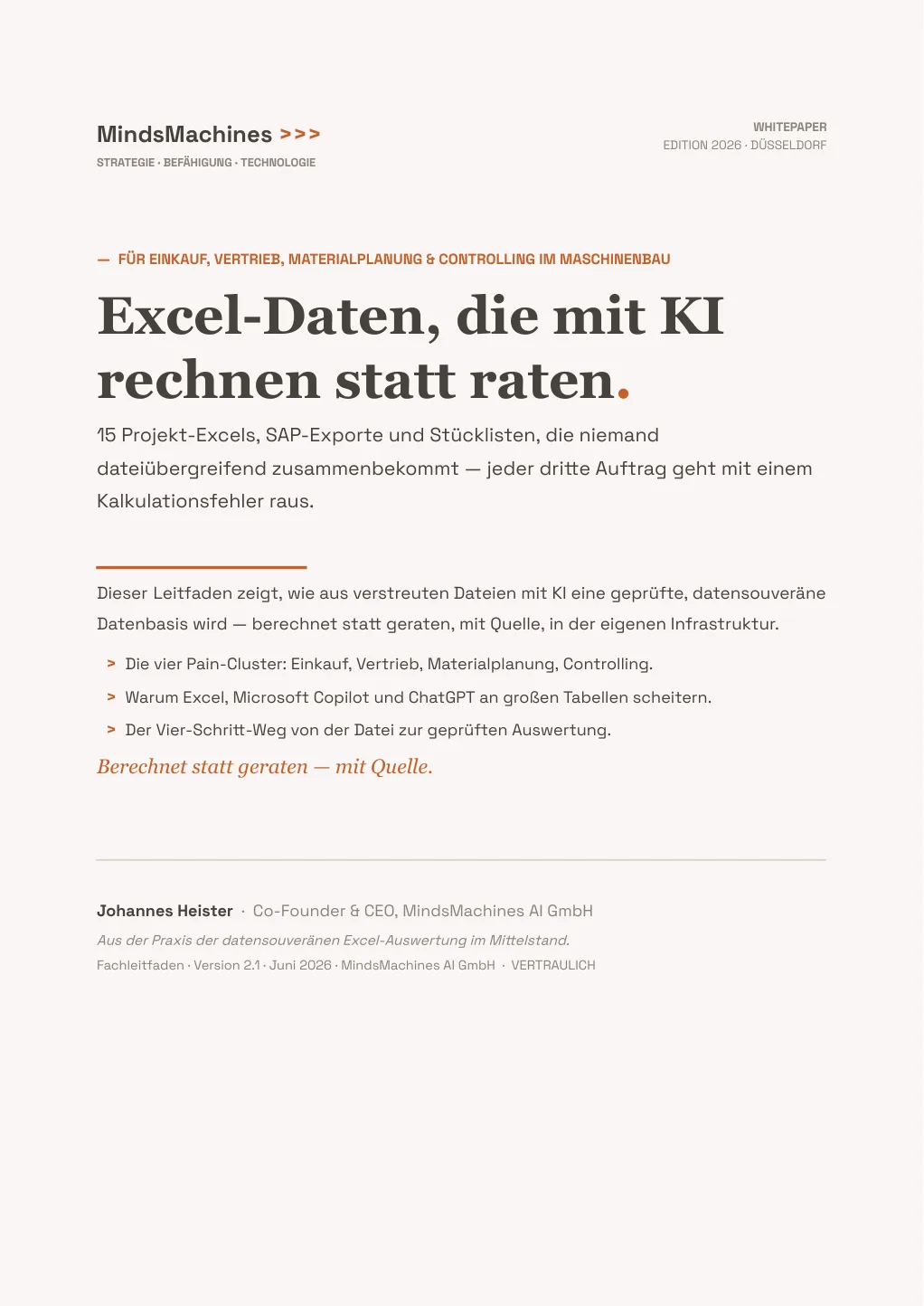
A practical guide for purchasing, sales, material planning and controlling in mechanical and plant engineering. It describes the four biggest problem areas, why Excel and generic AI assistants fail on large tables and the path in four steps from file to verified analysis.
German mechanical and plant engineering is under efficiency pressure in 2026. According to the PwC mechanical engineering barometer Q4/2025, 83 percent name cost pressure as the biggest obstacle to growth. According to VDMA 2025, only 7 percent have scaled generative AI across the company. The reason is rarely the technology but the data. Knowledge sits in Excel islands, SAP exports, quote folders and bills of materials, fragmented and impossible to analyse across files.
The guide describes the problem areas that weigh most heavily on purchasing, sales, material planning and controlling, and a concrete way forward. The existing Excel files become a verified data model that a person confirms. Calculated rather than estimated, with a source.
For purchasing, sales, material planning and controlling in mechanical and plant engineering, where knowledge sits in Excel files, SAP exports, quote folders and bills of materials.
Purchasing, sales, material planning and controlling, where scattered Excel islands and SAP exports cost the most.
From scattered files to a consolidated, verified data model, confirmed by a person.
Why large tables with calculations do not belong in a generic cloud AI.
Enter your details. The guide is then ready as a PDF, and the access link also arrives by email.
Information on how your details are processed is in the privacy policy.